Introduction
Material property prediction is critical for accelerating materials discovery, yet material tasks exhibit significant diversity (spanning electronic, thermal, mechanical properties across crystals, molecules, and more) and disparity (governed by distinct physical laws). Naively pre-train then fine-tune often fails to address these challenges, where a monolithic model suffers from negative transfer.
MoMa (Modular learning for Materials) reframes learning as modular composition. Instead of forcing all tasks into one shared model, MoMa trains specialized modules on diverse high-resource tasks and adaptively composes synergistic modules tailored to each downstream scenario, enabling effective knowledge reuse while mitigating interference.
Highlights
- 14% average improvement over the strongest baseline across 17 material property prediction tasks
- Best in 16 out of 17 tasks, spanning electronic, thermal, mechanical, and phonon-related properties
- 18 open-source modules released on Hugging Face for community reuse
- Superior few-shot performance under realistic label scarcity
Framework
MoMa operates in two stages: (1) Module Training & Centralization, which distills transferable knowledge from diverse high-resource tasks into a shared MoMa Hub; and (2) Adaptive Module Composition (AMC) & Fine-tuning, where MoMa selects and weights modules via a training-free kNN estimator and convex optimization, then fine-tunes the composed model.
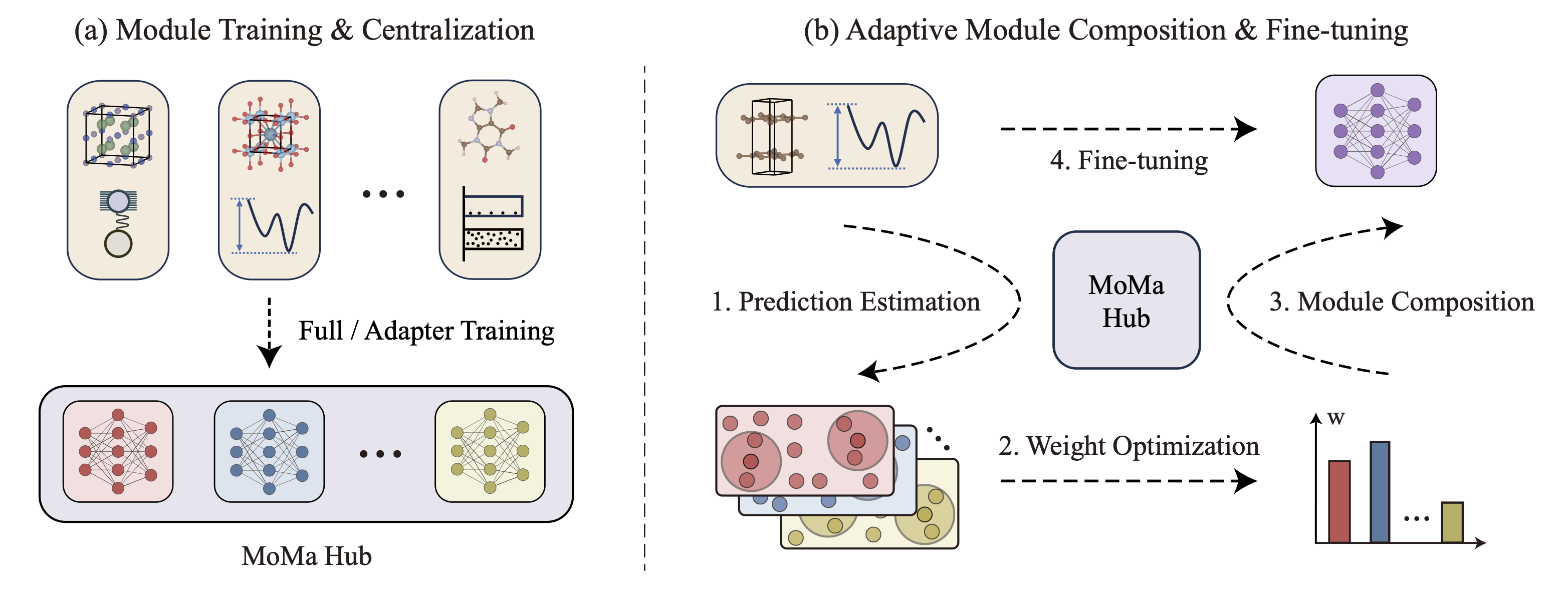
The MoMa framework. (a) Module Training & Centralization: train specialized modules and store them in MoMa Hub. (b) Adaptive Module Composition: estimate module relevance via kNN, optimize composition weights, and fine-tune.
Key Findings
Beyond strong empirical performance, our analysis reveals three insights about modular material learning:
Results
Evaluation across 17 downstream material property prediction tasks. All results are the average of five data splits (MAE).
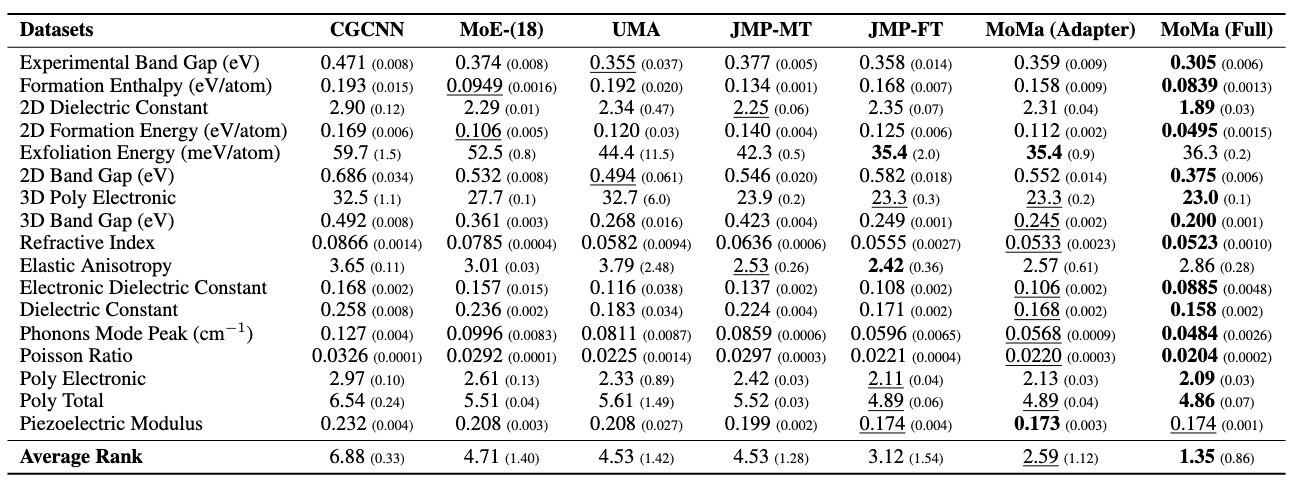
Main results for 17 material property prediction tasks. MoMa (Full) achieves the best average rank of 1.35, outperforming all baselines with an average improvement of 14%.
Citation
If you find this work useful, please cite our paper: